U.S. Supreme Court ruling: IEEPA tariffs unconstitutional

Screwed? On February 20, 2026, the U.S. Supreme Court ruled in a landmark 6-3 decision that the International Emergency Economic Powers Act (IEEPA) does not authorize the President to impose tariffs. This means that all reciprocal tariffs levied under IEEPA since January 2025 and the so-called trafficking/immigration tariffs
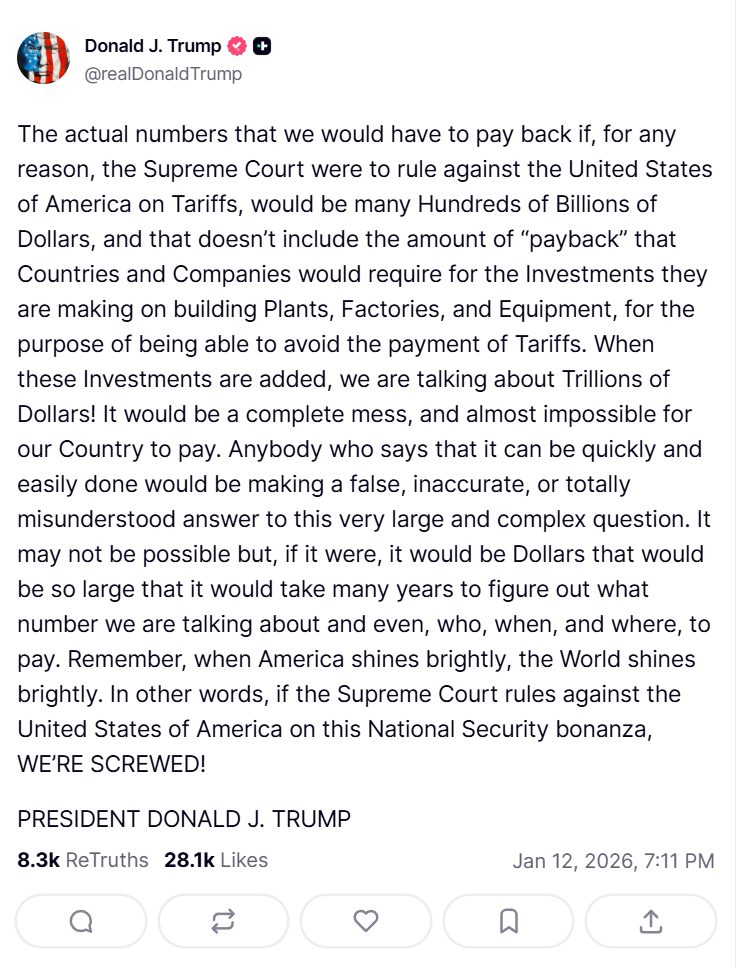
Screwed?
On February 20, 2026, the U.S. Supreme Court ruled in a landmark 6-3 decision that the International Emergency Economic Powers Act (IEEPA) does not authorize the President to impose tariffs. This means that all reciprocal tariffs levied under IEEPA since January 2025 and the so-called trafficking/immigration tariffs were declared unconstitutional in one fell swoop. This involves an estimated 133.5 billion US dollars in duties already levied - with forecasts for potential refunds of up to 175 billion US dollars. For importers, customs service providers and compliance officers, this is the most significant customs law development in recent US history.
This article analyzes the ruling, its immediate and medium-term impact on international trade, the new Section 122 tariffs enacted by the Trump administration in response, and the specific steps companies need to take now to secure their refund claims. We also highlight the executive branch's remaining tariff powers - including Section 232, Section 301 and Section 338 - which are likely to become more significant.
The key takeaways at a glance:
- IEEPA duties lapse immediately; however, refund mechanisms have not yet been finalized
- New Section 122 tariffs of 10-15% entered into force on February 24, 2026 - with a maximum duration of 150 days
- Importers must act immediately: Secure documentation, file protests, monitor liquidation status
- The administration has announced that it may challenge refund claims in court instead of paying them out automatically
Briefly the background
The IEEPA duties
On February 1, 2025, President Trump issued executive orders declaring national emergencies for drug trafficking and trade deficits - and used these as the legal basis for imposing tariffs under the IEEPA. What initially began as a targeted measure against specific trading partners was quickly expanded: Canada and Mexico were added in March 2025, and comprehensive reciprocal tariffs against virtually all U.S. trading partners were announced on April 2, 2025. At times, IEEPA tariffs accounted for around 50% of all US customs revenue - a historic state of emergency.
The countries affected ranged from China (highest tariffs) to Vietnam, the EU, Mexico, Canada and India, as well as numerous other trading partners. For companies worldwide - especially in export-oriented industries - this meant fundamental uncertainty when calculating import costs and supply chain planning.
The Supreme Court must get involved
The legal challenge to the IEEPA tariffs came faster than many had expected. In May 2025, both the U.S. Court of International Trade (CIT) and a U.S. District Court declared the IEEPA duties unlawful - but their decisions were stayed pending appeal, so the duties continued to be levied for the time being. In August 2025, the U.S. Court of Appeals for the Federal Circuit confirmed the invalidation in an en banc decision. On September 9, 2025, the Supreme Court accepted the case on an expedited basis; the oral hearing took place on November 5, 2025. On January 8, 2026, the Administration issued a Stipulation to refund IEEPA duties following a final, non-appealable judgment.
Constitutional question of principle
At the heart of the matter was the fundamental question of the separation of powers: Can the President levy tariffs independently by invoking economic emergency powers - or is this exclusively a matter for Congress? Article I of the US Constitution explicitly assigns the taxing power to Congress. The Supreme Court had to decide whether IEEPA - a law that gives the President broad economic emergency powers - implicitly includes the power to impose tariffs.
What's new?
1. the ruling: IEEPA does not authorize duties
On February 20, 2026, the Supreme Court ruled unambiguously by a vote of 6:3: IEEPA does not contain an explicit authorization to impose tariffs or duties. The Court clarified that tariffs are exclusively a "branch of the taxing power" reserved to Congress under Article I of the US Constitution. Chief Justice Roberts and Justice Kavanaugh were among the deciding votes.
This is crucial: The ruling declares not only the reciprocal tariffs unconstitutional, but also the so-called trafficking and immigration tariffs imposed under IEEPA. All IEEPA tariff categories are thus affected.
On the same day, President Trump issued an executive order to repeal the IEEPA tariffs - and at the same time a proclamation to introduce new tariffs under a different legal basis.
2. Section 122 tariffs: The substitute measure
In immediate response to the ruling, the Administration announced a new global tariff rate of 10% under Section 122 of the Trade Act of 1974, effective February 24, 2026 at 12:01 a.m. Eastern Standard Time. On February 21, 2026 - one day after the ruling - President Trump announced an increase to 15%.
Important: Section 122 allows the President to impose tariffs of no more than 15% for a period of 150 days to address balance of payments deficits. This means:
- Maximum duty rate: 15% (already fully utilized)
- Maximum duration: 150 days, i.e. expiration on July 24, 2026, unless extended, modified or terminated early by Congress
- Legal basis: Balance of payments deficit and economic security
3. exemptions from the Section 122 tariffs
The Proclamation on Section 122 duties contains an extensive list of exceptions, which are specified in Annex I and Annex II:
- USMCA-compliant goods from Canada and Mexico
- Section 232 items (steel, aluminum, automobiles, etc. - these are already subject to separate tariffs)
- Critical minerals
- Energy products
- Agricultural products
- Pharmaceuticals
- Certain electronic products
- Aerospace products
- Goods in Transit: Goods shipped before February 24, 2026 and imported by February 28, 2026 (On-Water Exception)
- GDR-CAFTA textiles (Costa Rica, Dominican Republic, El Salvador, Guatemala, Honduras, Nicaragua)
Companies should therefore carefully check whether their specific flows of goods fall under one of these exceptions.
4 Remaining customs powers: Section 232 and beyond
The Supreme Court ruling only affects IEEPA duties. The following duties remain in full force and effect:
- Section 232 (national security): 50% on steel and aluminum, 25% on automobiles, and various product-specific rates
- Section 301: Existing tariffs on Chinese goods remain unaffected
In addition, the Administration has directed the USTR to initiate new Section 301 investigations into unfair trade practices of major trading partners. The topics of investigation include:
- Industrial overcapacity
- Forced labor
- Pharmaceutical pricing
- Technology discrimination
- Marine pollution
- Trade barriers in seafood and rice
In addition, Section 232 and Section 338 investigations have been announced, which could potentially result in further tariffs.
5. Refund claims: The 175 billion dollar elephant in the room
By December 14, 2025, tariffs collected under IEEPA amounted to around 133.5 billion US dollars. Projections indicate potential refunds of up to 175 billion US dollars. However, the Supreme Court has not issued instructions on refund procedures or remedies.
The Administration has signaled that it may litigate refund claims rather than grant automatic refunds - despite the January 8, 2026, Stipulation. The U.S. Court of International Trade has exclusive jurisdiction over IEEPA duty challenges. The specific refund mechanisms have been announced as "forthcoming" - specific CBP or Treasury guidance is still pending.
Important: The fact that the Administration has declared the Stipulation for Refund does not mean that refunds will be automatic or timely. Companies must take action on their own to protect their claims.
Secretary of the Treasury Scott Bessent, in response to the ruling: litigation over refunds could turn into a months- or years-long process, and "could be a mess."
Impact Analysis
Operational changes
The immediate operational effects are considerable and require parallel action at several levels:
Refund Management: Companies must systematically process all imports that were subject to IEEPA duties - from January 2025 until the ruling takes effect. This includes Entry Summaries, Duty Payment Records, dates and the liquidation status of each import. The records must be organized by duty type: reciprocal duties, trafficking/immigration duties and country-specific rates to correctly allocate the respective amounts.
New Customs Classification: At the same time, all current imports must be assessed for the new Section 122 duties. Each individual shipment of goods must be checked to see whether one of the numerous exemptions applies. In many cases, this requires a new analysis of the rules of origin - especially for USMCA compliance - as well as the product-specific classification.
In-Transit Goods: For goods that were on water at the time of proclamation, a tight deadline applies: only goods loaded before February 24, 2026 and imported into the U.S. by February 28, 2026 qualify for the On-Water Exception. The documentation must be complete.
Resource Requirements: Companies should expect internal compliance teams as well as external customs consultants and attorneys to be significantly busier in the coming months. The parallel processing of refund claims, new customs valuation and strategic supply chain planning is a challenge that will require dedicated resources.
Supply chain planning
The 150-day time limit on Section 122 tariffs creates a particular planning problem: companies cannot currently predict with certainty which customs regime will apply from July 24, 2026. It remains to be seen whether Congress will extend the tariffs, the administration will use new powers (Section 301, Section 232, Section 338) or a partial vacuum will be created. Procurement decisions for the second half of 2026 are therefore fraught with uncertainty.
Financial impact
Reimbursement potential
The financial dimensions are considerable:
- Total volume of IEEPA duties levied (until December 14, 2025): approx. USD 133.5 billion
- Projected refund potential: up to USD 175 billion
- Share of total US customs revenue: approx. 50% in the survey period
For individual companies, the potential refunds can be substantial - provided claims are made correctly and on time. It is therefore particularly important to conduct a complete inventory of all IEEPA payments now.
Cost structure under new regime
The switch from IEEPA tariffs (in some cases well over 100% for Chinese goods) to Section 122 tariffs of a maximum of 15% means considerable relief for many importers - at least temporarily. However:
- Section 232 tariffs remain in full force (50% on steel/aluminum, 25% on automobiles)
- Existing Section 301 tariffs on Chinese goods also remain unchanged
- New Section 301 investigations could lead to further tariffs
- The 15% limit under Section 122 means that country-specific negotiation results exceeding 15% require a different legal basis
Legal and consulting costs
Companies should take into account that the enforcement of refund claims - especially if the administration disputes claims - can result in considerable legal costs. In most cases, hiring specialized U.S. Customs Counsel is not optional, but mandatory.
Compliance considerations
Regulatory requirements
The compliance landscape has fundamentally shifted with the ruling. The following points require particular attention:
Reimbursement procedures - two paths:
-
Entries already liquidated: CBP Form 19 protests must be filed within 180 days of the liquidation date. Since IEEPA duties have been collected since January 2025, some of these deadlines may already be expiring. Each individual entry must be reviewed for its individual liquidation status.
-
Entries not yet liquidated: Post-Summary Corrections (PSCs) may be filed prior to liquidation to claim duty refunds. Liquidation status must be continuously monitored via the Automated Commercial Environment (ACE).
Important: The distinction between liquidated and non-liquidated is absolutely critical to choosing the correct procedural path. Incorrect deadlines or incorrect forms can lead to the complete loss of the right to reimbursement.
Risk factors
- The administration has explicitly announced that it may challenge refund claims in court - this means potentially years of litigation
- There is currently no final CBP or Treasury guidance on the specific refund mechanisms
Documentation requirements
Companies must keep all entry documentation and internal records for the allocation of customs costs - both for potential litigation and for administrative procedures. This includes:
- All entry summaries and related payment receipts
- Internal cost allocation records (who ultimately paid the customs costs?)
- Correspondence with CBP
- ACE import reports with liquidation status
- Documentation to differentiate between the various customs types (reciprocal, trafficking, country-specific)
Measures
Immediate measures
-
Complete inventory of all IEEPA duty payments: Record all imports from January 2025 to February 2026 that were subject to IEEPA duties. Use ACE import reports for systematic recording.
-
Check liquidation status of each import: Identify which entries have already been liquidated and which are still pending. This will determine the correct procedural route (protest vs. PSC).
-
Calculate deadlines for already liquidated entries: For each liquidated entry, the 180-day period for filing CBP Form 19 protests begins on the liquidation date. Create a calendar of deadlines.
-
document in-transit goods: Ensure that all goods loaded prior to February 24, 2026 and imported by February 28, 2026 are fully documented to claim the on-water exception for Section 122 duties.
-
Hire U.S. Customs Counsel: Consult with specialized customs attorneys to develop a coordinated protest and litigation strategy.
We will be happy to support you with our partner in the USA in preparing the data
Short-term measures
-
submit Post-Summary Corrections (PSCs): For entries that have not yet been liquidated, PSCs must be submitted before liquidation in order to apply for customs refunds.
-
Submit CBP Form 19 Protests: Protests must be submitted on time for entries that have already been liquidated.
-
ensure Section 122 compliance: Evaluate all current imports for applicability of the new 15% duties and systematically check the exemptions in Annex I and II.
-
Evaluate USMCA compliance: For imports from Canada and Mexico: Confirm USMCA compliance to claim exemption from Section 122 duties.
-
Evaluate industry coalitions: For companies with high tariff exposure, participation in multi-importer actions in the Court of International Trade may make economic sense.
Long-term measures
-
Assess Section 301 risk: Analyze your supply chains in light of the announced Section 301 investigations by the USTR.
-
Monitor CBP and Treasury guidance: The specific reimbursement mechanisms are announced as "forthcoming" - stay tuned.
-
Section 122 phase-out planning: Prepare for July 24, 2026, when Section 122 tariffs expire. Develop scenarios for different successor regimes.
-
Track Section 232 and Section 338 developments: Announced investigations could lead to additional tariffs - integrate these risks into your sourcing strategy.
-
Watch country-specific trade agreements: The Administration is negotiating bilaterally - outcomes could affect duty rates beyond the 15% Section 122 cap.
Timeline
| Date | Event |
|---|---|
| February 1, 2025 | President Trump issues executive orders on national emergencies (drug trafficking, trade deficit); first IEEPA tariffs |
| March 2025 | Extension of IEEPA tariffs to Canada and Mexico |
| April 2, 2025 | Comprehensive reciprocal tariffs announced against all trading partners |
| May 2025 | CIT and District Court declare IEEPA tariffs unlawful (decisions suspended) |
| August 2025 | Federal Circuit affirms en banc the invalidation |
| September 9, 2025 | Supreme Court adopts expedited procedure |
| November 5, 2025 | Oral argument before the Supreme Court |
| December 14, 2025 | IEEPA customs revenue reaches approx. 133.5 billion USD |
| January 8, 2026 | Administration declares Stipulation for Refund after Final Judgment |
| February 20, 2026 Supreme Court ruling: IEEPA does not authorize tariffs (6:3); Executive Order on repeal; Section 122 Proclamation | |
| February 21, 2026 | Trump announces increase in Section 122 tariffs from 10% to 15% |
| February 24, 2026 | Section 122 tariffs go into effect (12:01 a.m. EST) |
| February 28, 2026 Deadline for On-Water Exception (shipment before 2/24, import until 2/28) | |
| July 24, 2026 Expiration of Section 122 duties (150-day period), unless extended | |
| November 2026 | U.S. Midterm Elections (political context for future tariff policy) |
Critical ongoing deadlines: The 180-day deadline for CBP Form 19 protests runs individually for each entry already liquidated. Companies with early IEEPA entries (January/February 2025) should immediately check whether deadlines have already expired or are imminent.
To summarize:
The U.S. Supreme Court's February 20, 2026 ruling marks a watershed in U.S. trade policy. The clear finding that IEEPA does not contain a customs power sets a constitutional limit on the expansive use of emergency powers to impose trade duties. For Congress, this means a strengthening of its original authority - for the executive branch, a reversion to more traditional, albeit still considerable, customs instruments.
The practical consequences for companies are enormous: on the one hand, there are potentially billions in refund claims, the enforcement of which is by no means automatic and may require lengthy legal proceedings. On the other hand, the new Section 122 tariffs of 15% have a built-in sunset clause - they expire after 150 days unless Congress acts. The administration has also made it clear that it will actively use its remaining arsenal - Section 232, Section 301, Section 338.